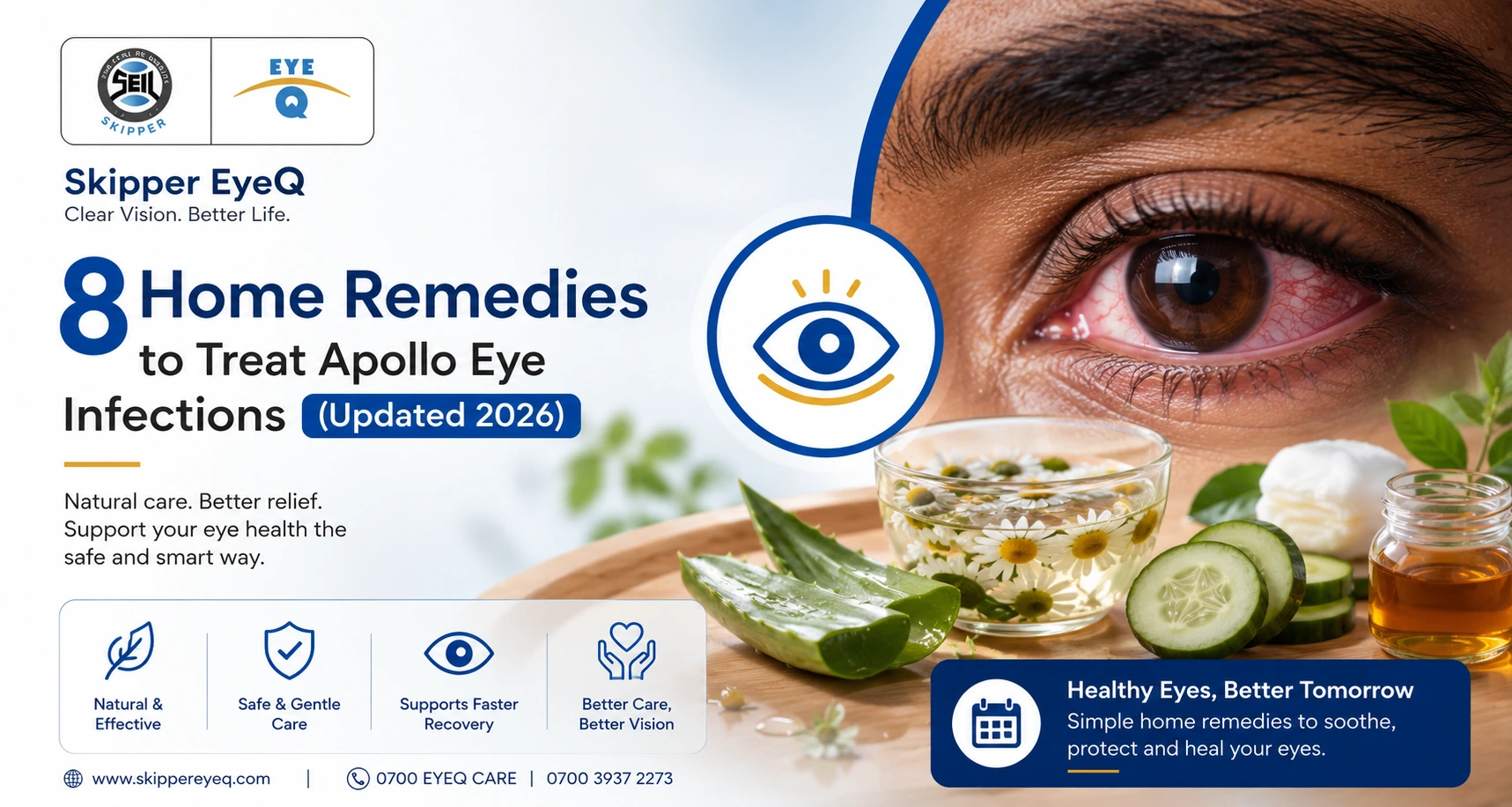
The 8 most effective home remedies for Apollo eye infection (conjunctivitis) are: (1) Saltwater rinse, (2) Warm compress, (3) Cold compress, (4) Raw honey eye wash, (5) Castor oil, (6) Green tea bags, (7) Colostrum for newborns, and (8) Tulsi (holy basil) water. These relieve symptoms only, they do not cure bacterial or severe viral infections. See a doctor if symptoms persist beyond 7 days.
Apollo eye infection, the common Nigerian name for viral conjunctivitis is one of the most prevalent and contagious eye conditions in West Africa, with outbreaks peaking during harmattan season and school terms. Most cases are viral and self-limiting, but the redness, discharge, and discomfort can be deeply uncomfortable. This guide covers 8 evidence-informed home remedies that can help manage symptoms, along with clear guidance on when home care is enough and when you need to see an eye specialist at Skipper Eye-Q.
For a full clinical overview of the condition itself, see our dedicated guide on how to cure Apollo eye disease and our page on the treatment of Apollo eye disease by type (viral, bacterial, allergic).
Apollo eye infection is the popular Nigerian and West African name for conjunctivitis inflammation of the conjunctiva, the transparent membrane covering the white of the eye and lining the inner eyelids. The name ‘Apollo’ comes from a 1969 epidemic of haemorrhagic conjunctivitis that coincided with the Apollo 11 moon landing.
| Type | Cause | Contagious? | Home Remedies Effective? |
|---|---|---|---|
| Viral (most common) | Adenovirus, enterovirus | YES — highly | YES — symptom relief |
| Bacterial | Staph, Strep, H. flu | YES | Partial — antibiotics needed |
| Allergic | Pollen, dust, dander | NO | YES — compresses, antihistamines |
| Irritant | Smoke, chemicals | NO | YES — rinse & compresses |
Important: Home remedies are most appropriate for viral and mild allergic conjunctivitis. Bacterial conjunctivitis often requires prescribed antibiotic eye drops. If you are unsure which type you have, read are your red eyes a sign of infection? before starting any home treatment.
Before starting home remedies, confirm your symptoms match Apollo/conjunctivitis rather than a more serious eye condition. See our full list of top common eye disorders and diseases to rule out other causes.
| Symptom | What It Looks Like | Indicates |
|---|---|---|
| Redness | Bloodshot whites, pink tinge | Inflammation of conjunctiva |
| Watery discharge | Clear, watery see | Viral conjunctivitis (most likely Apollo) |
| Yellow/green discharge | Thick pus, crusts overnight | Bacterial conjunctivitis, needs antibiotics |
| Itching | Persistent, worse with rubbing | Allergic conjunctivitis |
| Gritty sensation | Sand-in-eye feeling | Viral or bacterial infection |
| Light sensitivity | Squinting in normal light | Possible corneal involvement, see a doctor |
| Swollen eyelids | Puffy, tender lids | Moderate-to-severe infection |
If your eyes are watery without any other discharge, this may be allergic rather than infectious conjunctivitis, and antihistamines may work better than antibiotics or antimicrobial home remedies.
See our dedicated guide on tips to protect your eyes from conjunctivitis during monsoon for seasonal prevention strategies that work in the Nigerian climate.
Each remedy below includes: what it does, step-by-step instructions, safety notes, and evidence level. For a broader comparison of whether home remedies actually work for this condition, see our article home remedies for Apollo eye infections: do they work?.
Important safety note: All home remedies below are for symptom relief only. Never apply undiluted substances, urine, raw plant juices, or prescribed eye drops directly into your eye. If symptoms worsen after 48 hours of home treatment, stop and consult a doctor.
| Remedy | Best For | Evidence Level | Safety | Avoid If… |
|---|---|---|---|---|
| 1. Saltwater rinse | Discharge, crusting | Moderate | High | DIY concentration too strong |
| 2. Warm compress | Discharge, blepharitis, styes | High (AAO-backed) | High | Infection spreading |
| 3. Cold compress | Swelling, itching, redness | High | High | Severe pain or vision change |
| 4. Raw honey wash | Mild bacterial/viral | Low-moderate | Low-moderate | Allergy to bee products |
| 5. Castor oil | Dry, irritated eyes | Moderate | Moderate | Allergy to castor |
| 6. Green tea bags | Swelling, soothing | Moderate (anti-inflammatory) | High | Hot bags (burn risk) |
| 7. Colostrum (breast milk) | Neonatal conjunctivitis | Moderate (neonatal use) | High (newborns) | Adult infections |
| 8. Tulsi (holy basil) | Mild irritation | Low (traditional use) | Moderate | Direct eye contact without dilution |
Saline solution closely mimics the eye’s natural tears and has mild antimicrobial properties. It is effective at physically removing discharge, pus, and allergens from the eye surface, and is widely recommended as a first-line home measure for conjunctivitis symptom relief.
What it does: Mechanically clears discharge; antimicrobial properties reduce bacterial load on the eye surface
Evidence: Recommended by the American Academy of Ophthalmology as a supportive measure for conjunctivitis
Safety note: Never use table salt with iodine additive. Never apply hypertonic (overly salty) solution. Never use salt solution that has been stored overnight prepare fresh each time.
A warm compress is one of the most evidence-backed home remedies for eye infections and is explicitly recommended by the American Academy of Ophthalmology. It is particularly useful for loosening discharge that crusts the eyelids shut, and for relieving blepharitis that often accompanies recurrent eye infections.
What it does: Softens and loosens crusted discharge on eyelids; dilates meibomian glands to improve tear quality; soothes inflammation
Evidence: A 2014 clinical study of 22 participants showed warm compresses improve ocular surface health. Endorsed by AAO for infectious and non-infectious eye conditions.
Safety note: Do not use water that is uncomfortably hot. Do not press on the eyeball. If you notice the infection spreading to the other eye, stop and book a consultation at Skipper Eye-Q.
Where warm compresses help with discharge and gland function, cold compresses are better suited for the relief of itchy, inflamed, and swollen eyes particularly in allergic conjunctivitis or during the acute inflammatory phase of viral Apollo eye.
What it does: Constricts blood vessels to reduce redness and swelling; provides numbing relief from itching; reduces puffiness around the eyelids
Safety note: Never place ice directly on the eye or eyelid, it can cause ice burns to the delicate periocular skin. Do not press on the eye. Use the warm compress first if discharge and crusting are the main issue.
Warm vs Cold: When to use which?
Honey has well-documented antimicrobial, anti-inflammatory, and wound-healing properties. Research has shown that Manuka honey specifically can inhibit Staphylococcus aureus and Pseudomonas aeruginosa common bacterial causes of conjunctivitis. However, evidence for honey as a standalone treatment is still limited, and it should only be used as a supportive measure, not a replacement for prescribed antibiotics in bacterial cases.
What it does: Antimicrobial (inhibits bacterial growth); anti-inflammatory (reduces swelling and redness); creates a low-water environment unfavourable to bacteria
Safety note: Do not use commercially processed, sugared honey. Do not use undiluted honey directly in the eye. Do not use if you have a known bee product allergy. Stop immediately if burning or increased redness occurs.
Castor oil contains ricinoleic acid, an omega-9 fatty acid with documented anti-inflammatory properties. It is used in some lubricating eye drops as a base ingredient (notably Refresh Optive Advanced). As a home remedy, it can help with dry eye symptoms that worsen during an Apollo eye infection, and can reduce eyelid swelling when applied around (not inside) the eye.
What it does: Reduces periocular inflammation; lubricates the eyelid area; soothes itching associated with blepharitis
Safety note: Never instil castor oil directly inside the eye unless it is an ophthalmic-grade preparation. Keep away from the tear duct area. Do not use on children without medical supervision.
Green tea contains high concentrations of catechins (particularly EGCG) and tannins with documented anti-inflammatory and mild antimicrobial properties. Research published in the Journal of Agricultural and Food Chemistry demonstrated catechins from green tea can inhibit adenoviruses the primary cause of Apollo eye infection.
What it does: Reduces periocular swelling via vasoconstriction (tannins); anti-inflammatory catechins soothe irritated conjunctiva; provides a cooling, soothing physical sensation
Safety note: Never place warm or hot tea bags on the eye serious burn risk. Do not squeeze the bag to express tea directly into the eye. Chamomile tea bags are an alternative with similar anti-inflammatory properties.
Breast milk contains secretory IgA antibodies, lactoferrin, lysozyme, and epidermal growth factor — all of which have anti-infective properties. For neonatal conjunctivitis (ophthalmia neonatorum), small amounts of expressed breast milk have been used supportively in multiple studies. This remedy is specifically for newborns and infants; it is not recommended for adults.
What it does: Provides passive immunity via sIgA antibodies; lactoferrin binds iron needed by bacteria; lysozyme directly attacks bacterial cell walls
Safety note: Any newborn with eye discharge should be evaluated by a Skipper Eye-Q paediatric ophthalmologist immediately — neonatal conjunctivitis can be caused by gonorrhoea or chlamydia transmitted during birth, which require urgent systemic antibiotic treatment. Breast milk is supportive only and does not replace medical treatment.
See our children’s eye health and safety awareness guide for more on protecting newborn and infant eye health.
Tulsi (Ocimum sanctum) is a traditional Ayurvedic herb with documented antibacterial, antiviral, and anti-inflammatory properties. Laboratory studies have shown extracts of Ocimum sanctum inhibit Staphylococcus aureus and Streptococcus species — common bacterial causes of conjunctivitis. Clinical evidence in ophthalmology remains limited, so this remedy should be used as a supportive measure only.
What it does: Mild antimicrobial and anti-inflammatory properties; traditional use for conjunctivitis symptom relief
Safety note: Do not apply hot or warm tulsi water to the eye area. Do not apply undiluted tulsi juice or paste directly into the eye. If any irritation increases after application, stop immediately.
The following ‘remedies’ are commonly used in Nigeria and across West Africa for Apollo eye infection but have been shown to cause serious harm, including permanent vision loss. Skipper Eye-Q urges patients to avoid all of these:
| Harmful Remedy | Why People Use It | Why It Is Dangerous |
|---|---|---|
| Urine (human or animal) | Believed to be sterile and healing | Urine is NOT sterile; contains bacteria. Has caused severe corneal scarring and blindness. |
| Undiluted salt water | Perceived antimicrobial effect | Hypertonic solution damages corneal epithelium. Only use at prescribed dilution. |
| Soap / detergent | To ‘clean’ the eye | Causes severe chemical conjunctivitis; soap disrupts tear film |
| Lime / lemon juice | Vitamin C perceived as healing | Highly acidic; causes chemical burns to cornea |
| Petroleum jelly (Vaseline) | To soothe | Blocks meibomian glands; worsens infection |
| Raw onion juice | Traditional remedy | Highly irritating; can cause epithelial damage |
Viral Apollo eye infection typically lasts 7 to 14 days with or without home treatment. Home remedies shorten symptom severity but do not shorten the viral replication cycle.
For a detailed breakdown by infection type, see our full guide on how long Apollo eye infection lasts.
| Type | Without Treatment | With Home Remedies | With Medical Treatment |
|---|---|---|---|
| Viral (Apollo) | 7–14 days | 5–10 days (symptom relief only) | No antivirals typically; supportive only |
| Bacterial | Up to 2 weeks | Marginal improvement | 3–5 days with antibiotics |
| Allergic | Ongoing (until allergen removed) | Partial relief | Antihistamines most effective |
Apollo eye infection (viral conjunctivitis) is one of the most contagious conditions in routine clinical practice. A single infected household member can infect everyone in the home within 24 to 48 hours. See our precautions for viral conjunctivitis guide for a full prevention protocol, and our 10 tips for avoiding eye infections for year-round hygiene habits.
Do not attempt to manage Apollo eye infection at home if any of the following are present. Book an urgent consultation at Skipper Eye-Q.
Skipper Eye-Q operates specialist ophthalmology clinics at four locations across Lagos and Abuja. See all locations and opening hours.
Once you have recovered from an Apollo eye infection, the following measures reduce your risk of re-infection or spreading it to others during future outbreaks. See our complete prevention guide: how to prevent Apollo eye infection.
Apollo eye infection is uncomfortable but manageable at home in the majority of viral cases. The 8 remedies in this guide saltwater rinse, warm compress, cold compress, honey, castor oil, green tea bags, colostrum, and tulsi water are the most evidence-supported options available. Use them to relieve symptoms, practice strict hygiene to prevent spread, and stay informed about the warning signs that require professional care.
If you or a family member has an Apollo eye infection that is not improving after 7 days at home, book a consultation at Skipper Eye-Q. We have ophthalmologists available at four locations across Lagos and Abuja. Find your nearest branch.
There is no medical difference. ‘Apollo’ is the West African colloquial name for epidemic haemorrhagic conjunctivitis, popularised during a 1969 outbreak that coincided with the Apollo 11 moon landing. Medically, it is the same condition as viral conjunctivitis. For a full explanation, see our article on conjunctivitis: causes, symptoms and treatment.
No. Viral conjunctivitis cannot be cured in 24 hours the viral replication cycle takes time regardless of treatment. However, symptoms can be significantly reduced within 24 to 48 hours through consistent use of warm/cold compresses, saltwater rinses, and avoiding eye rubbing. For urgent relief options, see our guide on how long Apollo eye infection lasts.
No, undiluted tulsi juice or paste should never be applied directly to the eye. Only use cooled tulsi water as a compress or rinse around the eye. Direct instillation of undiluted botanical extracts can cause irritation and in some cases serious corneal damage.
Home remedies do not reliably kill bacteria causing conjunctivitis. Only antibiotic eye drops prescribed by a doctor can reliably eradicate bacterial conjunctivitis. For a complete guide to antibiotic options, see our article on antibiotics for pink eye. If you suspect bacterial Apollo eye (thick yellow-green discharge throughout the day), book a consultation at Skipper Eye-Q rather than attempting to treat it at home.
The safest approaches for children are warm compresses, saline rinses (properly diluted), and strict hygiene. Avoid honey, castor oil, tulsi, and essential oil-based remedies in young children without medical advice. See our children’s eye health guide for age-specific advice. If the child has thick discharge, pain, or significant light sensitivity, see a doctor immediately.
No. Remove contact lenses at the first sign of any eye infection and do not resume wearing them until all symptoms have completely resolved and you have completed any prescribed treatment. Book a comprehensive eye examination at Skipper Eye-Q before resuming lens wear after an infection.
No. You cannot contract Apollo eye infection by looking at an infected person. Transmission requires direct contact with infected eye secretions, touching contaminated surfaces then touching your own eye, or sharing personal items (towels, pillows, eye drops). Airborne transmission is not a route for conjunctivitis.


Have you ever noticed tiny spots or threads floating across your vision when looking at a bright sky or a plain wall? Or perhaps you've seen sudden flashes of light,...
Read More
If you're dealing with pain in your right eye along with a headache, it's most often one of a handful of familiar causes a migraine, a tension headache, a sinus...
Read More
Apollo, medically referred to as conjunctivitis occurs from inflammation of the eye's transparent membrane, known as the conjunctiva. This inflammation is triggered by infection or irritation caused by bacterial, viral,...
Read More