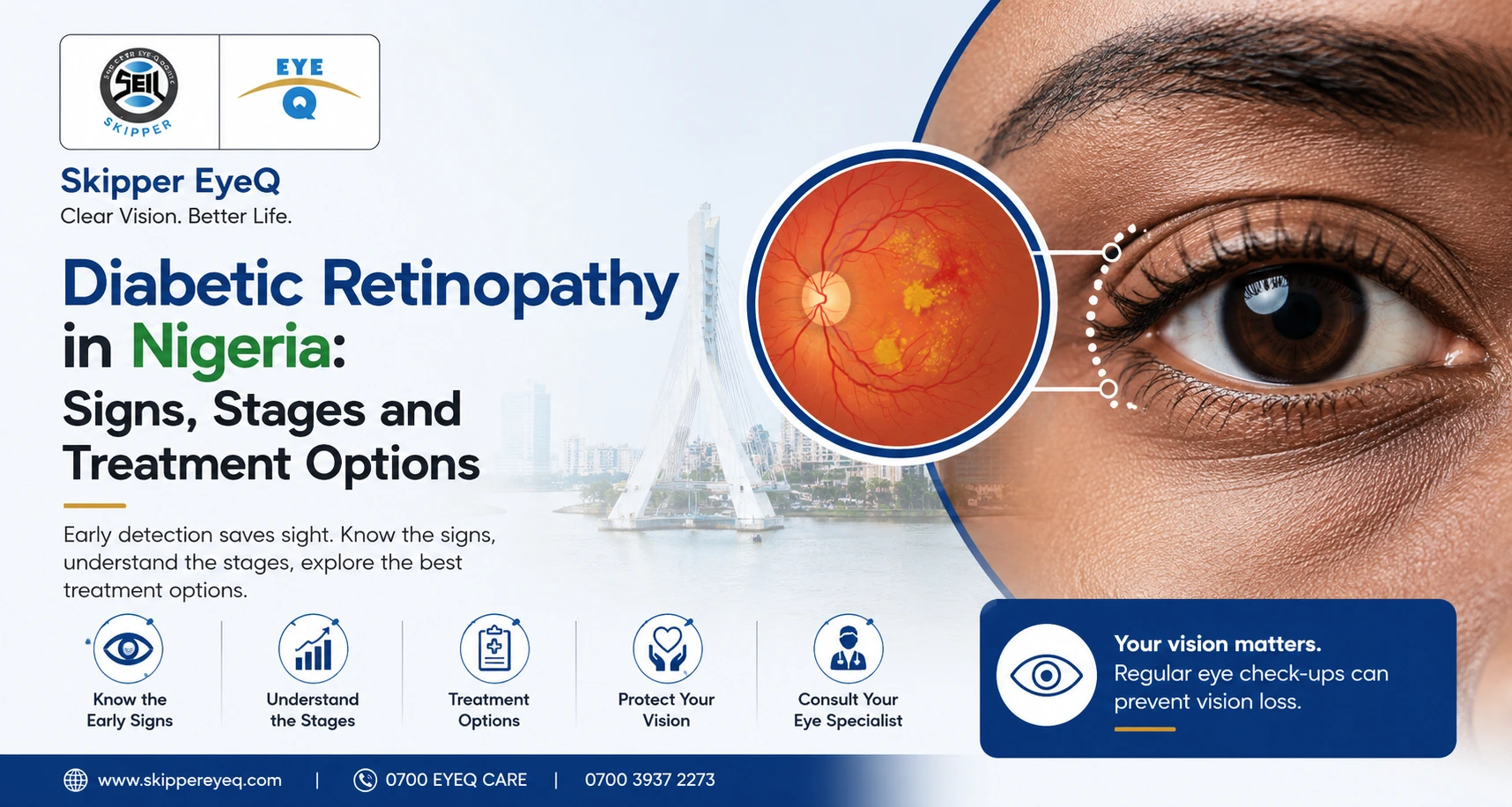
Diabetic retinopathy is an eye disease caused by high blood sugar damaging the tiny blood vessels at the back of the eye. It is the leading cause of preventable blindness in working-age adults in Nigeria. The disease moves through 4 stages, often without any pain or warning. Early signs include blurry vision, dark floaters, and trouble seeing colours. It cannot be fully cured, but laser treatment, eye injections and surgery can stop it from getting worse. Anyone with diabetes should get a yearly retina exam.
If someone in your family has diabetes, this blog matters to them. Diabetes does not just affect blood sugar — it slowly damages the tiny blood vessels in the retina, the screen at the back of the eye that lets us see. Over time, this damage causes vision loss, and sometimes complete blindness.
The frustrating part? It usually shows no early symptoms. Many Nigerians only notice when half the damage is already done. The good news is that with the right check-ups and treatment, most people keep their sight.
Diabetic retinopathy is an eye condition that affects people with type 1 or type 2 diabetes. Long-term high blood sugar weakens the small blood vessels in the retina. These weak vessels start to leak fluid or blood, swell up, or close off completely. In late stages, brand new but fragile vessels grow, which bleed easily.
When this happens, the retina cannot send clear pictures to the brain. Vision becomes blurry, dark spots appear, and parts of the picture go missing. If left alone, the damage becomes permanent.
How it affects your sight depends on which part of the retina is damaged:
This is the part that catches most people off guard. In its early stage, the disease has no signs at all. Your vision feels totally normal even while damage is building up. That is why doctors call diabetic retinopathy a silent disease.
As the condition advances, the diabetic retinopathy symptoms below begin to appear:
| Early Sign | What You’ll Notice |
| Floaters | Black spots or thread-like shapes drifting across your vision |
| Blurry vision | Words and faces look fuzzy, even with your glasses on |
| Trouble with colours | Colours look washed out or faded |
| Dark or empty patches | Missing parts of the picture, like a hole in your view |
| Difficulty at night | You struggle to see in low light or while driving at night |
| Sudden vision drop | A big change overnight is a serious sign — see a doctor the same day |
Some of these signs also show up with other conditions like foggy vision in one eye, so a proper retina exam is the only way to be sure.
Doctors split the disease into 4 diabetic retinopathy stages. Knowing the stage helps you and your doctor decide what to do next.
Tiny balloon-like swellings called microaneurysms appear in the retina’s blood vessels. There are usually no symptoms. Most patients only find out during a routine eye exam.
More blood vessels swell and start to leak. Some close off, blocking blood from reaching parts of the retina. Vision is usually still fine, but a doctor can see the damage clearly during an eye check.
Many more vessels are blocked. Areas of the retina lose their blood supply. The retina sends signals asking for new vessels to grow. Vision may start to blur in this stage. Treatment usually begins here to prevent the next stage.
This is the advanced stage. New, weak blood vessels grow on the surface of the retina and into the jelly inside the eye. They bleed easily and form scar tissue, which can pull the retina away from the back of the eye. This stage can cause severe vision loss or blindness if not treated quickly.
| Important: Many patients also develop diabetic macular oedema (DMO) at any of the 4 stages. This is when fluid leaks into the central part of the retina, causing the worst vision loss. It needs treatment even at early stages. |
Diabetes is rising fast in Nigeria. According to the International Diabetes Federation, more than 3.6 million Nigerians live with diabetes today, and many more are undiagnosed. Studies in Lagos and other cities show that around 1 in 3 diabetics already have some level of diabetic retinopathy by the time they get their first eye exam.
A few reasons make the picture worse here:
The disease is now one of the top three causes of preventable blindness in working-age Nigerians. The encouraging news is that proper screening and modern treatment can prevent vision loss in most cases.
A retina specialist can diagnose the condition with a simple set of tests in under an hour:
All of these tests are part of a proper comprehensive eye examination, which everyone with diabetes should book once a year — even if their eyes feel fine. To learn more about the condition itself, see our guide on diabetic retinopathy causes, symptoms and treatment.
| Short answer: No, it cannot be fully cured. But it can be controlled, and early changes can sometimes be reversed with very tight blood sugar control. |
In stages 1 and 2, getting your blood sugar under control may bring the eyes back close to normal. Vision can stabilise, and some leakage can heal.
From stage 3 onward, the goal shifts. Treatment focuses on stopping the disease from getting worse and protecting the vision you still have. Damage already caused, like blocked blood vessels and scar tissue, usually cannot be reversed. This is why catching it early changes everything.
The right diabetic retinopathy treatment depends on the stage, the part of the retina affected and whether macular oedema is present. Most modern treatments aim to seal leaking vessels, dry up swelling and stop new abnormal vessels from growing.
This is the foundation of every treatment plan. Without it, no eye procedure works for long. Patients are sent back to their physician to get HbA1c, blood pressure and cholesterol under target.
Drugs like ranibizumab, aflibercept and bevacizumab are injected into the eye to shrink leaking vessels and reduce swelling. Most patients need a series of injections over months. They are now the first-choice treatment for diabetic macular oedema.
A focused laser is used to seal leaking vessels or shrink abnormal new ones. It is commonly used in advanced stages and works well to prevent further vision loss.
For severe bleeding into the eye or retinal detachment, the surgeon removes the cloudy jelly inside the eye and clears scar tissue. Vision often improves within weeks.
For some cases of macular oedema that don’t respond to anti-VEGF, the doctor may use a steroid injection or a tiny long-acting implant inside the eye.
All of these treatments are offered at Skipper Eye-Q. You can read more about our retina surgeries and treatments and check our retina treatment cost in Nigeria.
Patients often ask: does the treatment actually work? The honest answer is yes, in most cases — but only if you start early. Here is what current research shows:
| Treatment | Success Rate |
| Anti-VEGF injections (for macular oedema) | Vision improves or stabilises in about 9 out of 10 patients |
| Laser treatment for proliferative retinopathy | Reduces the risk of severe vision loss by 50% or more |
| Vitrectomy for advanced bleeding | Useful vision is restored in 70% to 80% of cases when done early |
| Tight blood sugar control alone (early stages) | Slows or halts progression in roughly 70% of patients |
These numbers depend heavily on how soon you start. Patients who walk in within the first year of mild symptoms have a much better chance of keeping good vision than those who wait until vision is already poor.
If you or a loved one has diabetes, these habits cut the risk dramatically:
| It is silent in early stages — yearly screening is the only way to catch it early.
There are 4 stages, and treatment is most effective in the first three. It cannot be cured but it can be stopped from getting worse. Anti-VEGF injections, laser and surgery save vision in most patients when started early. Tight blood sugar control remains the most powerful tool you have. |
Diabetic retinopathy is damage to the retina caused by long-term high blood sugar in people with diabetes. It weakens tiny blood vessels in the back of the eye, causing leaks, swelling and abnormal new vessels. This leads to blurry vision, dark floaters, missing patches, and in severe cases, blindness.
There are usually no early signs. As the condition advances, watch for floaters (small black dots or threads), blurry vision, faded colours, dark or empty patches in your sight, and trouble seeing at night. Sudden vision loss is a medical emergency. A yearly retina exam catches the disease before symptoms appear.
Very common. Around 1 in 3 Nigerian diabetics already have some retinopathy by the time they get their first eye exam. With over 3.6 million people living with diabetes in Nigeria and late diagnosis being common, the disease is now a top cause of preventable blindness in working-age adults.
It cannot be fully cured. In early stages, very tight blood sugar control can sometimes reverse mild changes. In later stages, treatments like laser, injections or surgery stop the disease from getting worse and protect remaining vision. Damage already done usually cannot be undone, which is why early screening matters.
The best treatment depends on the stage. Options include strict blood sugar control, anti-VEGF eye injections (ranibizumab, aflibercept), laser photocoagulation, vitrectomy surgery for severe bleeding, and steroid implants for stubborn macular oedema. Most patients need a combination, plus lifelong follow-up.
The 4 diabetic retinopathy stages are: (1) Mild non-proliferative — small swellings in vessels, (2) Moderate — vessels leak and some close, (3) Severe — many vessels blocked, (4) Proliferative — abnormal new vessels grow and bleed. Diabetic macular oedema can occur at any stage and needs separate treatment.
Anti-VEGF injections improve or stabilise vision in around 9 out of 10 patients with macular oedema. Laser cuts severe vision loss risk by half or more. Vitrectomy restores useful vision in 70-80% of advanced cases when done early. Success rates depend heavily on starting treatment quickly.
Living with diabetes? Book your yearly retina check.
Skipper Eye-Q has dedicated retina specialists, OCT scans, fundus cameras and full laser and injection facilities at all 4 Nigeria branches. 18+ years of care. 10 million+ patients treated worldwide. The earlier you come in, the more vision we can save.
Lagos: 020-1700-4924 | Abuja: 020-1700-4925 | Book online


Have you ever noticed tiny spots or threads floating across your vision when looking at a bright sky or a plain wall? Or perhaps you've seen sudden flashes of light,...
Read More
If you're dealing with pain in your right eye along with a headache, it's most often one of a handful of familiar causes a migraine, a tension headache, a sinus...
Read More
Apollo, medically referred to as conjunctivitis occurs from inflammation of the eye's transparent membrane, known as the conjunctiva. This inflammation is triggered by infection or irritation caused by bacterial, viral,...
Read More