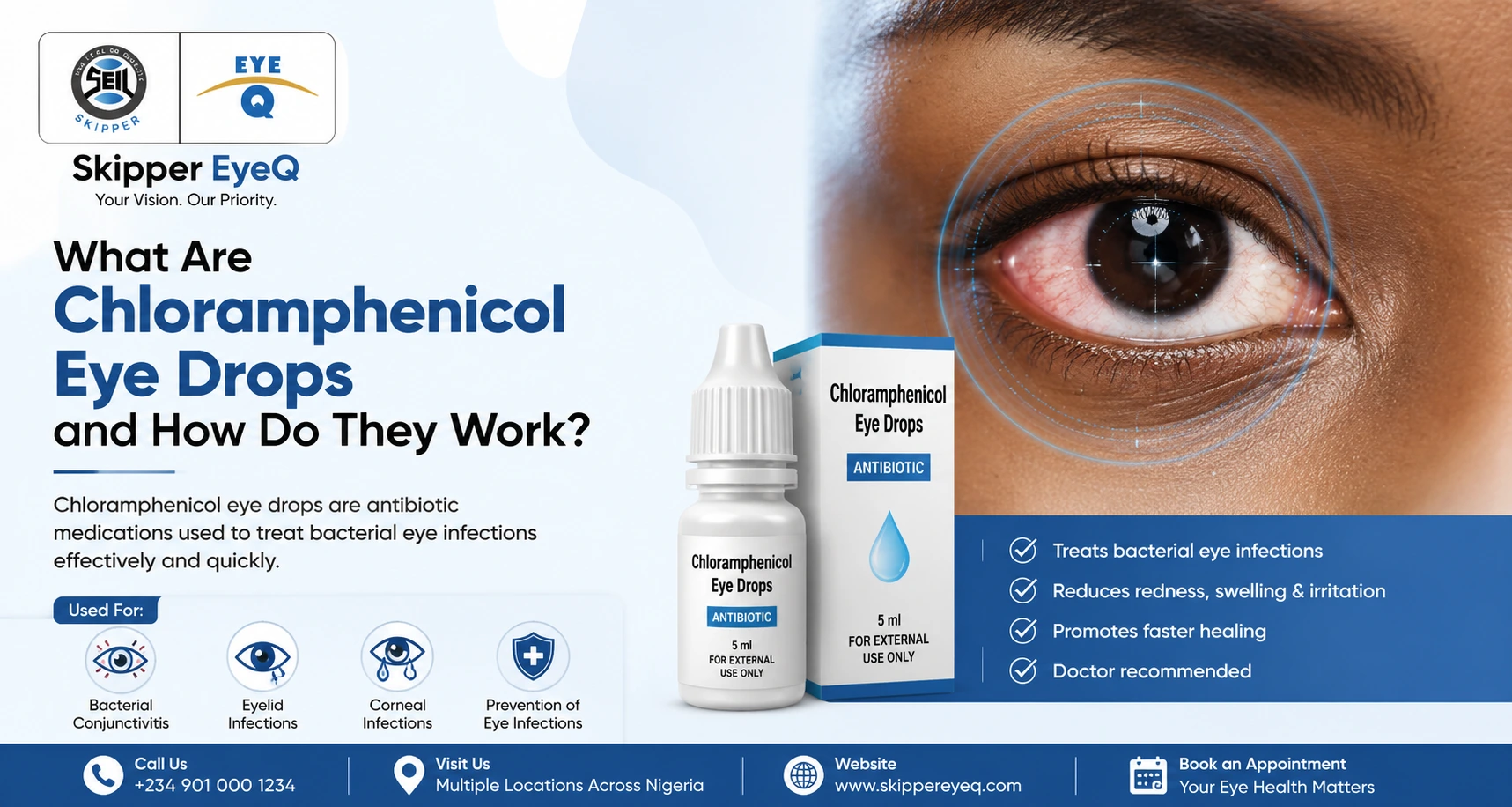
Chloramphenicol eye drops are antibiotic eye drops that are utilized to cure specific eye infections caused by bacteria; these include bacterial conjunctivitis. In case you are searching for any information regarding chloramphenicol eye drops, this guide will provide useful information on usage, mechanism of action, administration, dosing, side effects, precautions, and when to visit an eye specialist.
It should be noted that chloramphenicol does not help in viral or allergic eye diseases.
Chloramphenicol eye drops are a type of antibiotic medicine applied directly to the eye. They are used to treat bacterial eye infections, such as conjunctivitis (pink eye), in which the eye becomes red, watery, and uncomfortable.
The medicine comes in two forms. One is a liquid that you drop into the eye. The other is an ointment that you apply along the edge of the eyelid. Your doctor will decide which one suits your infection and how severe it is.
These drops have been in use for many decades. Doctors in Nigeria and across the world still prescribe them regularly because they work well for common bacterial eye infections and are generally well tolerated.
This medication is indicated in the treatment of specific bacterial eye infections that affect the outer layer of the eye. It is used in cases of bacterial conjunctivitis and other susceptible bacterial infections of the eye. This medication does not work on viral and allergic infections of the eye even if the symptoms mimic each other.
Getting the drops into your eye correctly matters. Here is a simple method that works for most people:
Wash your hands before you start. Tilt your head back slightly or lie down. Pull the lower eyelid down gently with one finger to create a small pocket.
Hold the bottle above the eye without letting the tip touch your eye or eyelid. Squeeze one drop into that pocket. Close your eye gently for a minute or two. Try not to blink hard or squeeze your eye shut.
If you are applying ointment, the method is similar. Pull the lower lid down, squeeze a small amount of ointment into the inner corner of the lower lid, then close your eye slowly and let it spread.
For children who resist drops, ask someone to help hold the child still. It can be useful to have the child lie on a bed with their head in your lap. A gentle approach and a calm voice help more than forcing it.
Chloramphenicol antibiotic eye drops work by stopping bacteria from making proteins they need to survive. Without those proteins, the bacteria cannot grow or multiply. Over time, the infection clears up.
It is worth knowing that chloramphenicol only works on bacterial infections. It will not do anything for a viral infection or an allergic reaction, even if the symptoms look similar. This is why a proper diagnosis matters before you start any antibiotic drops.
At Skipper Eye-Q, our doctors carefully examine your eyes before prescribing any antibiotic. We look at the type of discharge, the pattern of redness, and other signs to confirm whether it is bacterial before putting you on chloramphenicol or any other treatment.
Parents often worry when a baby or young child develops a sticky or red eye. Chloramphenicol eye drops for infants is sometimes prescribed, but it depends on the age of the child and the cause of the infection.
In very young babies, a sticky eye in the first weeks of life can have different causes, including a blocked tear duct, which is not an infection at all. In those cases, antibiotics are not the right treatment. A gentle massage along the side of the nose is usually recommended instead.
If a bacterial infection is confirmed in an older infant or child, a doctor may prescribe chloramphenicol drops. The dosage and frequency are adjusted based on the child’s age and weight.
If you are unsure whether your infant needs antibiotic eye drops, please bring them to our clinic. Do not guess with a baby’s eyes. Our pediatric eye team sees young children regularly and will give you clear advice on the right next step.
The chloramphenicol dosage for eye drops depends on the severity of the infection and your age. The general guide for adults and older children is as follows:
One drop into the affected eye or eyes every two hours for the first 48 hours. After that, if the infection is improving, you reduce to one drop every four hours. You continue this routine until the course is finished, usually five days in total.
Some people find the two-hourly schedule during the day hard to keep up. Try to stick to it as closely as you can during waking hours. The drops do not need to be used through the night when you are asleep.
For infants and young children, the dosage is decided by the doctor based on the child’s age. Never use an adult dose for a child. Always follow what your doctor tells you, not what is on the general packaging.
If you are using the ointment form, a small amount, roughly the size of a rice grain, is placed along the inner edge of the lower eyelid. This is usually done three to four times a day or as directed by your doctor.
One important rule: always finish the full course even if your eye looks better after two or three days. Stopping early can allow bacteria to come back, and the next infection may be harder to treat.
Both chloramphenicol eye drops and ointment contain the same active medicine. The difference is in how they are applied and how long they stay in contact with the eye.
Drops are easier to apply and do not blur your vision much after use. They are a good option during the day when you need to see clearly for work, school, or driving.
Ointment stays in contact with the eye for longer, which means it keeps working for more hours after each application. This makes it useful at night or when you need fewer daily applications. The downside is that it can make your vision a little blurry for a few minutes after you put it in.
Some patients use both. Drops during the day and ointment before bed. Your doctor will tell you what combination works best for your situation.
Not everyone should use these drops. Here are situations where they should be avoided or used only under close medical supervision:
Very young newborns, particularly those in the first few weeks of life, should only receive these drops if a doctor has specifically prescribed them and confirmed the cause of the infection.
If you are not sure whether these drops are right for you, our doctors at Skipper Eye-Q will review your full medical history and give you an answer based on your specific situation.
Chloramphenicol eye drops may cause temporary stinging, burning, irritation or blurred vision after application. More serious reactions require medical attention.
Most people tolerate chloramphenicol eye drops without any problems. The most common side effects are temporary. You might feel a slight stinging or burning sensation when you first put the drop in. This usually passes within a minute.
Some people notice a mild blurring of vision right after applying the drops. This clears on its own within a few minutes.
Less commonly, some people develop a mild redness or irritation that was not there before starting the drops. If this gets worse instead of better, stop using them and contact your doctor.
Serious side effects from the eye drops are very rare because very little of the medicine gets absorbed into the bloodstream. The serious blood-related side effects of chloramphenicol that you may have read about are mainly associated with its older tablet and injection forms, not the eye drops used for surface infections.
This is a question we hear often. The honest answer is that chloramphenicol is a broad-spectrum antibiotic, meaning it works against a wide range of bacteria. In that sense, yes, it is effective.
However, compared to the newer antibiotics used for severe internal infections, it is not what most doctors would call a “heavy-duty” antibiotic in that context. For eye surface infections, it does the job well and has a long record of doing so.
Doctors choose it for eye infections specifically because it gets into the eye tissue easily and reaches the bacteria causing the problem. That is what matters for a surface infection.
Yes, chloramphenicol is one of the established treatments for bacterial eye infections. It has been used in eye care for many years because it covers the bacteria most likely to cause conjunctivitis and similar surface eye infections.
Whether it is the right choice for your specific eye problem depends on what is actually causing the infection. Bacterial infections respond to it well. Viral infections and allergic reactions do not respond to it at all.
At Skipper Eye-Q, we do not prescribe antibiotics unless we are confident a bacterial cause is present. This protects your eyes and helps prevent antibiotic resistance, which is a growing problem across all of medicine.
The standard course is five days. Some doctors may extend this to seven days if the infection is more persistent or if there was a delay in starting treatment.
Even if your eye looks and feels completely better after three days, continue the drops until the course ends. Stopping early gives surviving bacteria a chance to grow back, and the next infection may not respond as well to the same medicine.
If you finish the full course and the eye is still not improving, go back to your doctor. It may not be a bacterial infection, or the bacteria may not be responding to chloramphenicol, in which case a different antibiotic or a different treatment is needed.
Chloramphenicol eye drops are available over the counter in some places, but that does not mean you should always use them without seeing a doctor first.
Go to the doctor straight away if:
Your vision has changed or is blurry in a way that does not clear after blinking. You have pain inside the eye, not just surface irritation. The redness is severe or spreading to the skin around the eye. You have had a recent eye injury. Your child is a newborn or very young infant. The infection is not improving after two days of treatment or is getting worse.
These signs suggest something more serious may be going on that needs proper examination, not just antibiotic drops.
Skipper Eye-Q brings the quality of Indian eye care to Nigeria. Our doctors are trained in ophthalmology and handle everything from routine infections to complex surgery.
When you come to us with an eye infection, we do not just hand you a prescription and send you home. We look at your eye properly, find out what is causing the problem, and explain your treatment to you clearly. If chloramphenicol is the right treatment, we will tell you how to use it correctly and what to watch for. If something else is needed, we will tell you that too.
We treat children, adults, and elderly patients. Our clinic is set up to handle paediatric eye care, which means your infant or young child is in safe hands when you bring them to us.
If you have an eye infection or any other eye concern, book a consultation at Skipper Eye-Q. Good eye care does not have to be complicated. It starts with seeing the right doctor.
People with a known allergy to chloramphenicol should not use them. Those with a history of aplastic anaemia should also avoid them unless cleared by a specialist. Pregnant women, breastfeeding mothers, and newborn babies should only use them after speaking with a doctor. If you are unsure, visit Skipper Eye-Q Indian Eye Hospital in Lagos or Abuja and our doctors will check your history before recommending any treatment.
It is a broad-spectrum antibiotic that works against many types of bacteria. For bacterial conjunctivitis and other surface eye infections, it is one of the most reliable first-choice options used by eye doctors in Nigeria and globally. It is not used for serious internal infections in modern medicine, but for treating bacterial pink eye and conjunctivitis at the eye surface, it is effective and well-established.
The standard adult dosage is one drop in the affected eye every two hours during waking hours for the first 48 hours, then one drop every four hours for the rest of the five-day course. For children, the dosage is set by the doctor. Never apply more than one drop at a time, extra drops run off and do not improve the result.
Yes. For bacterial conjunctivitis and bacterial pink eye, chloramphenicol is a well-established treatment. It penetrates the eye tissue well and reaches the bacteria causing the problem. However, it only works for bacterial infections. Viral conjunctivitis and allergic pink eye will not respond to these drops. This is why a correct diagnosis before starting treatment is essential.
The standard course is five days. Some cases may require up to seven days. Always complete the full course even if the eye feels better early, stopping before the course ends gives bacteria a chance to survive and return. If the eye is still infected after finishing the full course, see an eye doctor in Lagos or Abuja for a reassessment.
They may be available at some pharmacies, but buying and using them without a proper diagnosis is not recommended. Bacterial conjunctivitis, viral pink eye, and allergic conjunctivitis look similar but require completely different treatments. Using the wrong drops delays recovery and contributes to antibiotic resistance. Visit Skipper Eye-Q Indian Eye Hospital in Lagos or Abuja for a proper diagnosis before starting any antibiotic eye drops.
They can be prescribed for children when a bacterial eye infection has been confirmed by a doctor. The dosage is adjusted based on the child’s age and the severity of the infection. For very young infants, particularly newborns, they should only be used if specifically prescribed by a doctor after a clinical assessment. If your child has a red or sticky eye in Lagos or Abuja, bring them to Skipper Eye-Q Indian Eye Hospital for proper evaluation rather than self-treating.


Have you ever noticed tiny spots or threads floating across your vision when looking at a bright sky or a plain wall? Or perhaps you've seen sudden flashes of light,...
Read More
If you're dealing with pain in your right eye along with a headache, it's most often one of a handful of familiar causes a migraine, a tension headache, a sinus...
Read More
Apollo, medically referred to as conjunctivitis occurs from inflammation of the eye's transparent membrane, known as the conjunctiva. This inflammation is triggered by infection or irritation caused by bacterial, viral,...
Read More