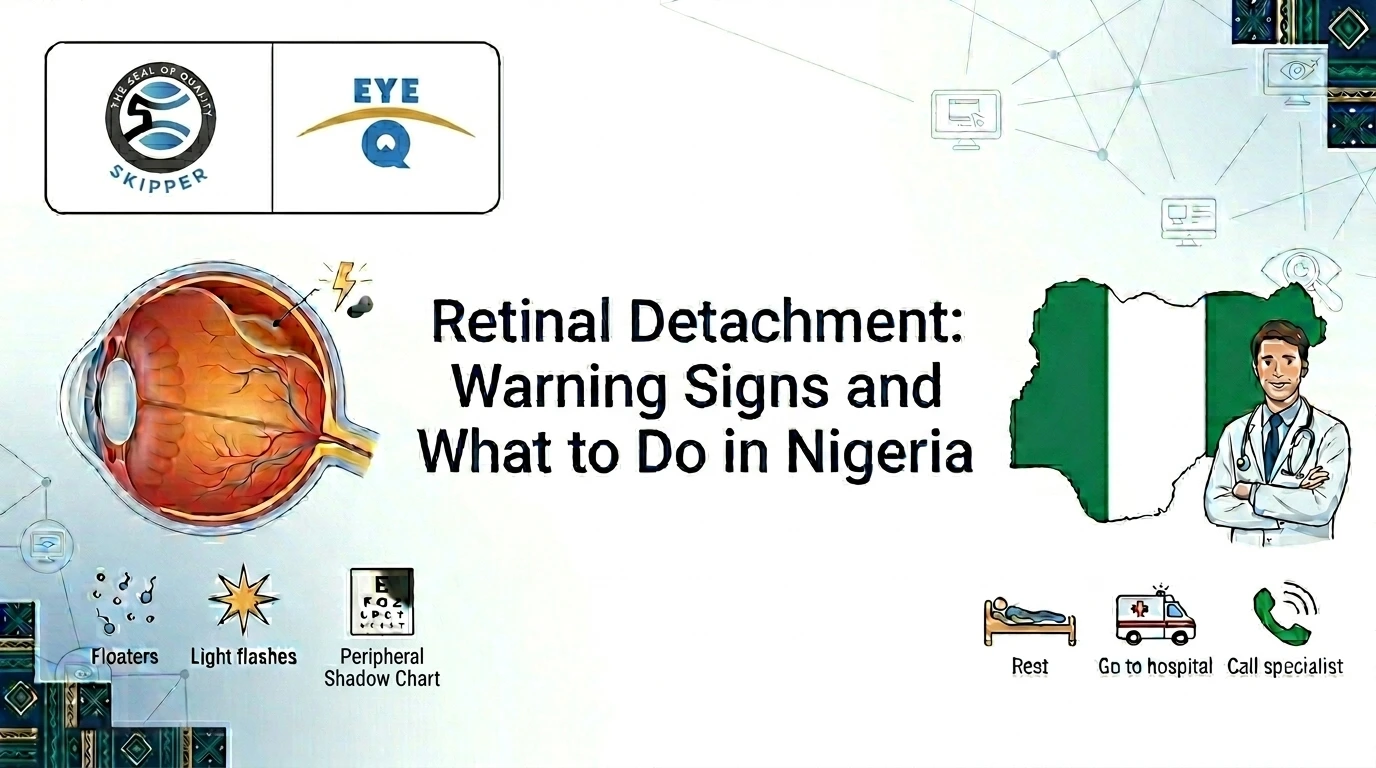
Imagine the back of your eye like the screen of a cinema. The retina is that screen. It catches light and sends pictures to your brain. Now imagine the screen starts peeling off the wall. That is what happens in retinal detachment.
In Nigeria, many patients reach the hospital too late, often after weeks of ignoring symptoms or trying home remedies. By then, the damage is hard to reverse. This guide explains the warning signs in plain language, so you can act fast and protect your sight.
Retinal detachment is a condition where the retina, the thin light-sensing layer at the back of the eye, pulls away from the tissue that holds it in place. Once detached, the retina stops working properly, because it is no longer getting oxygen and nutrients from the blood vessels beneath it.
It is very serious. Doctors class it as an eye emergency, the same level as a heart attack is for your chest. Every hour matters. If the retina stays detached for more than a few days, the cells start to die, and vision loss may become permanent even after surgery.
The good news: if you reach a retina specialist quickly, around 90 out of every 100 retinas can be put back in place. Most patients keep useful vision in that eye.
Retinal detachment does not hurt. There is no pain, no redness, no swelling. That is exactly why people ignore it. Look out for these four signs instead:
| Warning Sign | What It Feels Like |
| Floaters | Small black dots, cobwebs or tiny threads that float across your vision, especially when you look at a plain wall or the sky. |
| Flashes of light | Quick flashes, like lightning or camera flash, usually at the side of your vision, even with your eyes closed. |
| A dark shadow or curtain | A grey or black shadow that slowly covers part of the picture in one eye, as if a curtain is being pulled across. |
| Sudden blurry or missing vision | Part of the image in one eye goes blurry or disappears. The other eye usually sees fine. |
An occasional floater is normal, especially as you get older. But if floaters suddenly increase, or come with flashes, treat it as a warning. These symptoms can also appear with other problems like blurry vision in one eye, so a proper eye exam is the only way to be sure.
The causes of retinal detachment are mostly the same everywhere, but a few things make it more common in Nigeria:
Delayed eye care. In Nigeria, many people only visit an eye hospital when things get really bad. Small retinal tears picked up early can be sealed with a laser in minutes, but untreated tears grow into detachments.
| Short answer: No. Stress alone does not cause retinal detachment. But heavy stress can raise blood pressure and blood sugar, which damage the eye’s blood vessels over time. |
Many patients ask if stress caused their retinal detachment, because the problem often shows up after a difficult week at work or a personal crisis. The honest answer is that stress is not a direct cause.
However, stress is linked to a different eye condition called central serous retinopathy (CSR). In CSR, fluid builds up under the retina and makes central vision blurry. CSR is not the same as true retinal detachment, and it usually clears up on its own. Only a retina specialist can tell the two apart.
Yes, it can. If retinal detachment is not treated, the eye will almost certainly lose its sight. A fully detached retina that is left for weeks can lead to complete blindness in that eye, even if surgery is done later.
This is why doctors call it an emergency. The window to save full vision is small. Here is roughly how timing affects outcomes:
| Time from symptoms to surgery | Chance of good vision recovery |
| Within 24 hours | Very high — most patients recover most of their vision |
| Within 1 week | Good — vision is saved, but may not be 100% sharp |
| 1 to 4 weeks | Moderate — useful vision is saved in many cases |
| More than 4 weeks | Low — central vision is often lost even after surgery |
The other eye usually remains fine. But because the same risks affect both eyes, patients are told to watch the good eye very carefully for the rest of their life.
If you see sudden floaters, flashes, a dark curtain or a big drop in vision in one eye, treat it as an emergency. Here is exactly what to do:
Do not wait for it to settle. Retinal detachment never gets better on its own.
In Lagos, call 020-1700-4924. In Abuja, call 020-1700-4925. If you cannot get through, book an emergency appointment online. Skipper Eye-Q offers a VIP fast-track service for eye emergencies like this.
Remember: Lagos traffic is unpredictable. Leave early. Do not wait till morning if symptoms appear at night, if the hospital has an on-call number for emergencies.
Retinal detachment treatment almost always needs a procedure. Eye drops and medicines alone cannot put the retina back. The choice of treatment depends on the size, location and type of detachment.
If your tear is caught very early, before the retina fully peels off, the doctor can seal it with a laser. This is a quick, painless office procedure. No cutting, no stitches.
A tiny silicone band is placed around the eye from the outside. It gently pushes the eye wall inward so the retina can settle back in place. The band stays in forever but is not visible.
The surgeon removes the jelly inside the eye and replaces it with a gas or oil bubble. The bubble holds the retina in place while it heals. This is the most common surgery for moderate to large detachments.
A small gas bubble is injected into the eye. The patient then has to keep the head in a special position for several days so the bubble presses on the tear. Used for some small, specific detachments.
At Skipper Eye-Q, all four procedures are available under one roof. You can learn more on our retina surgeries and treatments page.
Retinal detachment surgery recovery is slow and needs patience. The eye heals over weeks, not days. Here is a rough timeline for most patients:
| Time After Surgery | What to Expect |
| First week | Vision is very blurry. You may see the gas bubble as a dark line. Some soreness and watering. Head positioning may be needed. |
| 2 to 4 weeks | Vision starts to clear. The bubble slowly shrinks. You can return to light desk work. |
| 1 to 3 months | Most of the vision that will return has returned. Air travel is usually still not allowed if a gas bubble is still present. |
| 3 to 6 months | Full recovery. Final glasses prescription is checked. Regular retina follow-ups continue. |
You cannot fully prevent retinal detachment, but you can lower the risk:
Know your family history. If a close relative has had retinal detachment, tell your eye doctor.
| Retinal detachment is an emergency, not a wait-and-watch problem.
There is usually no pain, which is why people miss it. Four warning signs: floaters, flashes, a dark curtain, and sudden vision loss in one eye. The first 24 hours matter most for saving vision. Retinal detachment treatment is surgery, and most patients keep good vision if treated early. |
What is retinal detachment and how serious is it?
Retinal detachment is when the retina, the light-sensing layer at the back of the eye, peels away from the eye wall. It is a medical emergency. Without quick treatment, it leads to permanent vision loss or blindness in that eye. Surgery usually fixes it if done within days.
What are the early warning signs of retinal detachment?
The main warning signs are a sudden increase in floaters (black dots or cobwebs), flashes of light, a dark shadow or curtain moving across your vision, and sudden blurry or missing vision in one eye. There is usually no pain, which is why people often ignore it.
What causes retinal detachment in Nigeria?
The main causes are strong short-sightedness, age over 50, eye injuries, uncontrolled diabetes, family history and past eye surgery. In Nigeria, late diagnosis is a major reason why small retinal tears turn into full detachments.
Can retinal detachment lead to permanent blindness?
Yes. If retinal detachment is not treated within days to weeks, the retinal cells start dying from lack of oxygen and blood supply. This causes permanent loss of vision or complete blindness in the affected eye. Early surgery saves vision in most cases.
What should I do immediately if I notice symptoms?
Go to an eye hospital the same day. Do not drive yourself. Do not rub the eye. Avoid bending or lifting. Call Skipper Eye-Q Lagos (020-1700-4924) or Abuja (020-1700-4925) to book an emergency slot. The sooner the retina is reattached, the better your vision outcome.
Can stress cause retinal detachment?
No, stress alone does not cause retinal detachment. But long-term stress can raise blood pressure and blood sugar, which damage the retina’s blood vessels over time. Stress can also trigger a milder problem called central serous retinopathy, which should not be confused with true detachment.
How long is retinal detachment surgery recovery?
Retinal detachment surgery recovery takes 3 to 6 months for full healing. Vision is blurry for the first 1 to 2 weeks. Most patients return to light work after 2 to 4 weeks. Heavy lifting, swimming and flying are restricted until the doctor clears them.


Have you ever noticed tiny spots or threads floating across your vision when looking at a bright sky or a plain wall? Or perhaps you've seen sudden flashes of light,...
Read More
If you're dealing with pain in your right eye along with a headache, it's most often one of a handful of familiar causes a migraine, a tension headache, a sinus...
Read More
Apollo, medically referred to as conjunctivitis occurs from inflammation of the eye's transparent membrane, known as the conjunctiva. This inflammation is triggered by infection or irritation caused by bacterial, viral,...
Read More